REVIEW · JERUSALEM
Private Walking Tour in the Old City of Jerusalem
Book on Viator →Operated by talitour · Bookable on Viator
Jerusalem clicks into place on foot. This private walking tour with licensed guide Tali takes you through the Old City quarters and the biggest Holy Land sites, from Jaffa Gate to the Church of the Holy Sepulchre. Pickup is offered, and you’ll use a mobile ticket day-of.
I love the way Tali connects each stop to the bigger story, including the Armenian presence around St. James Church and the ancient Roman footprint you’ll see in the Jewish Quarter. I also like the tight pacing: admission tickets are handled for several key places, so you spend your time listening and walking, not figuring out logistics.
One consideration: there are no snacks included, and the stops are intentionally short. Plan to stand and look a lot, and note that some major landmarks are observed from outside rather than toured inside.
In This Review
- Key highlights to expect
- Walking the Old City like a living map (3 hours, private and practical)
- Jaffa Gate: your orientation in the first 10 minutes
- Armenian Quarter courtyard and art: St. James Church area in focus
- Jewish Quarter streets, houses, the Roman Kardo, and the Hurva area
- Western Wall and the Temple Mount view: where the Old City widens
- Muslim Quarter market lanes: shops, stalls, and everyday Jerusalem
- Christian Quarter and the route to Holy Sepulchre
- Church of the Holy Sepulchre: chapels and Golgotha Hill
- Price and value: what $450 per group buys you
- Pickup, meeting point, and pacing you can count on
- Who should book this private Old City walk
- Should you book this Old City tour with Tali?
- FAQ
- How long is the private walking tour in the Old City of Jerusalem?
- Where does the tour start and end?
- Is pickup included?
- What’s included in the tour price?
- Are snacks included?
- Is this tour only for my group?
- What is the cancellation policy?
Key highlights to expect

- Private guide for up to 6 people, so the pace stays flexible
- Admission included at multiple stops, with one major archaeology stop listed as free
- Temple Mount and Mount of Olives viewpoints from the Western Wall area
- Real market time in the Muslim and Christian quarters, not just photo stops
- Church of the Holy Sepulchre focus on chapels and Golgotha Hill
- Pickup offered + mobile ticket for a smoother start
Walking the Old City like a living map (3 hours, private and practical)
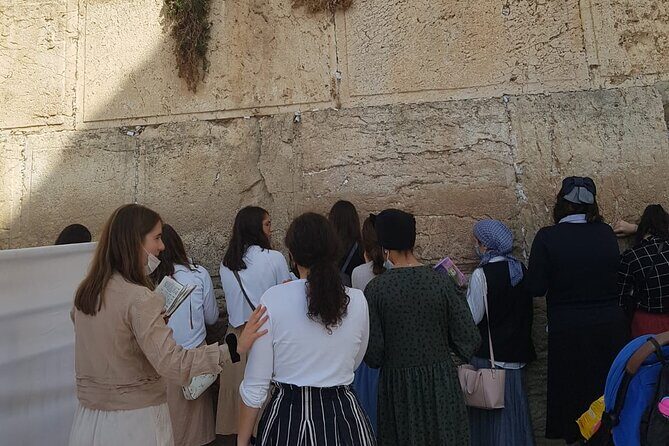
This is a private walking tour built for your first, second, or even third day in Jerusalem when you want the Old City to make sense fast. With a group size capped at up to 6, you’re not stuck watching from the edges while everyone else moves ahead. It also means Tali can slow down for questions, kids, or anyone who just needs a minute to process what they’re seeing.
The total time is about 3 hours, and the route is designed to hit the big landmarks across the different quarters. You’ll move at a steady pace, with each stop getting a set amount of time. That structure is a plus if you want clarity, but it can feel fast if you’re hoping for a long, quiet sit-down at every site.
A smart part of the value is the mix of viewpoints, courtyards, market lanes, and sacred sites. You’re not only collecting monuments. You’re also getting the day-to-day Old City texture that helps the stories land.
You can also read our reviews of more walking tours in Jerusalem



Jaffa Gate: your orientation in the first 10 minutes
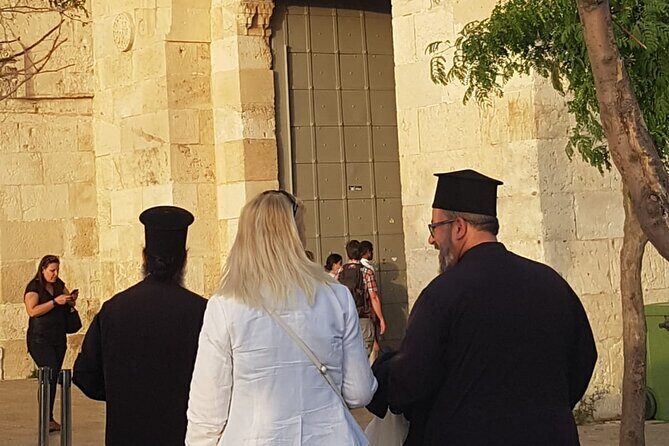
You start at Jaffa Gate (near the Jaffa Gate hostel), the main entrance into the Old City. This first stop is doing real work. Tali explains why it’s called the Jaffa Gate, how the city walls shaped movement and defense, and who built the wall system and why.
Even if you’ve seen photos of Jaffa Gate a dozen times, the practical benefit is orientation. Once you understand the gate and the walls, the rest of your walk reads like a map instead of a random string of sights. You’ll also get the breakdown of how the Old City is divided into quarters, which helps when you bounce from Armenians to Jews to Muslims to Christians.
This is also where you’ll feel the rhythm of the tour: a brief but focused introduction, then you move on. If you’re the type who likes to linger at thresholds and arches, this part will feel short—but it sets you up for the longer conversations at later stops.
Armenian Quarter courtyard and art: St. James Church area in focus
In the Armenian Quarter, the tour turns from walls and entrances to community life. You’ll hear about why Armenians are an important part of Jerusalem’s story and why they have a longstanding presence there. Then you’ll spend time in the courtyard of St. James Church, which gives the quarter a calmer, more grounded feel right after the gate.
One of the more enjoyable parts here is the art element. The route includes an Armenian art gallery stop, so this isn’t just about sacred architecture. It’s also about how people express identity through art, symbols, and religious culture.
If you care about seeing how faith communities live and create, this stop usually lands well. The time is limited, so keep your questions short and specific. Ask what you’re looking at, not what you wish you had time to read.
Jewish Quarter streets, houses, the Roman Kardo, and the Hurva area
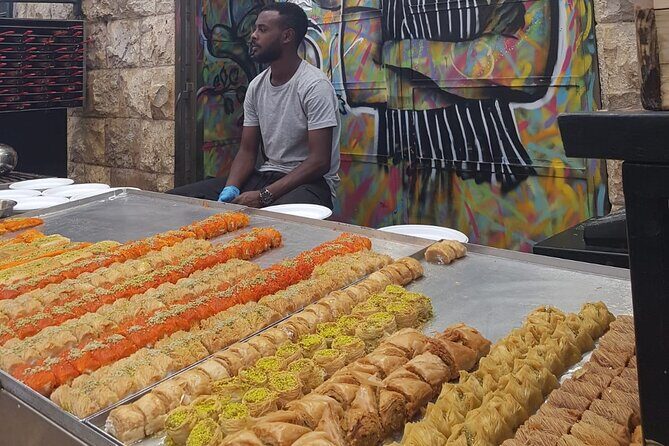
The Jewish Quarter portion is where the tour leans hard into layers of time. You’ll walk around the Jewish Quarter houses and get the sense of how the area developed and changed. Even though you’re moving quickly, the walking matters because it helps you understand the neighborhood as a living grid, not just an attraction.
Then comes Kardo, described as an old Roman road/archway element still visible in the area. Tali uses the archaeology and finds to explain what was discovered there and what it tells you about Jerusalem during Roman times. This stop is marked as ticket-free, which is a small but real value win inside a tour that otherwise includes admissions.
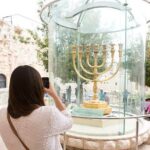
Next is the Hurva Synagogue area. You observe the synagogue and spend time at the synagogues square of the Jewish Quarter. The tour also references a model of the Temple lampstand. Importantly, you don’t enter the synagogue itself; you’re there for the exterior view and the interpretive space around it.
A practical note: because this segment mixes archaeology, synagogue context, and a lot of symbolism, it’s easy to feel like you’re collecting information quickly. If you want to squeeze more meaning from it, pick one theme for yourself—Roman Jerusalem, synagogue history, or how models and symbols help people remember the Temple.
Western Wall and the Temple Mount view: where the Old City widens
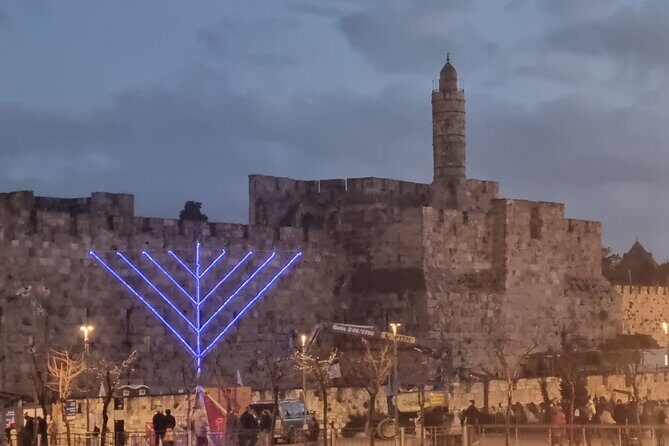
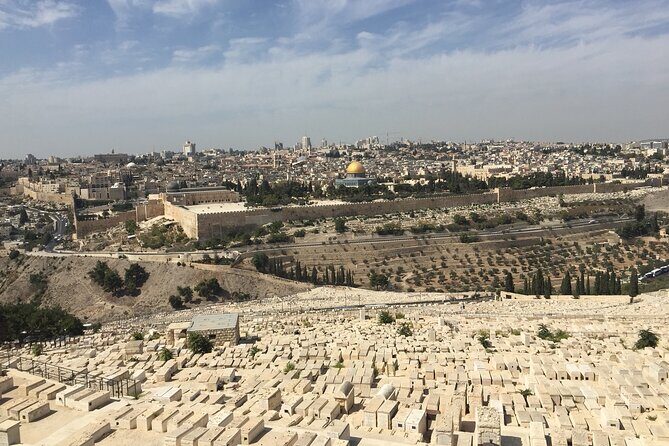
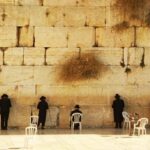
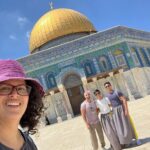
At the Western Wall, you’ll see the remnant of the retaining wall from the Temple Wall. This is one of the stops that makes the Old City feel physically tied to the ancient world. You’ll also observe the Temple Mount and the Mount of Olives from this area, which gives you a helpful visual link between different sacred sites across the city.
The tour time here is longer than several earlier stops—about 20 minutes—because the Western Wall area rewards a slower look. Tali’s job at this point is to explain what you’re seeing and why this section matters in the chain of sacred geography.
You should expect a respectful setting and lots of attention on the main features. The value of doing this with a guide is not only knowing what it is, but also understanding how the Wall relates to the bigger Temple-era context you’ve been hearing about in earlier stops.
You can also read our reviews of more city tours in Jerusalem






Muslim Quarter market lanes: shops, stalls, and everyday Jerusalem
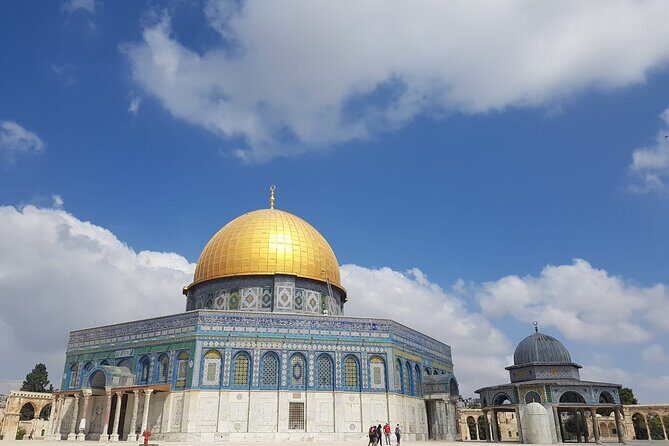
The Muslim Quarter stop brings you into sensory, street-level Jerusalem. You visit the authentic Muslim market, where you’ll see shops and stalls as part of the experience, not just as background.
This is a good break from heavy sacred-site focus. Markets are how you understand a city as people actually use it. The tour keeps it short—about 15 minutes—so treat it like a guided orientation. You’ll learn what to notice and what the space represents, then you can decide what you want to explore further on your own.
A helpful strategy: during this segment, keep your spending simple. The tour doesn’t say anything about shopping, and the focus is seeing. If you do buy something, do it because you like it, not because you feel rushed by the clock.
Christian Quarter and the route to Holy Sepulchre
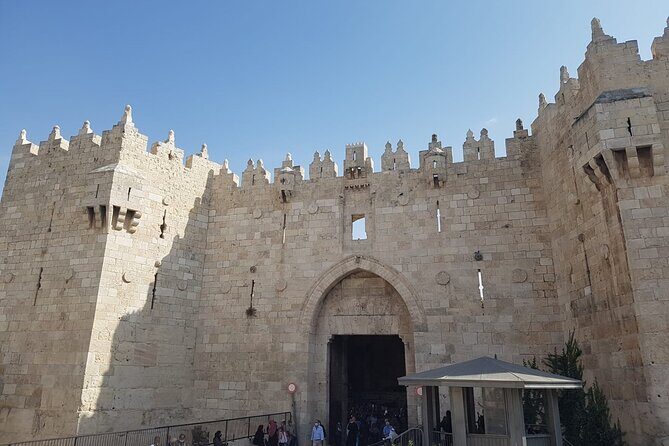
Next, you walk into the Christian Quarter, where you get to know the area layout and pass through the Christian market. You’ll also pass by famous churches in the quarter, which helps connect what you see on the street with what you came to Jerusalem to understand spiritually and historically.
This stop is about 20 minutes, which is just enough to get the feel of the neighborhood and then funnel you toward the main event.
After you’ve been moving through symbolism and community spaces, the arrival point at the Church of the Holy Sepulchre lands with more weight. By the time you’re there, you understand the idea that this site preserves layered sacred memories rather than one single moment frozen in time.
Church of the Holy Sepulchre: chapels and Golgotha Hill

The final stop is the Church of the Holy Sepulchre, described as preserving the place of the crucifixion of Jesus and the place of his burial. You’ll visit the various chapels and focus on Golgotha Hill, with Tali guiding what you should pay attention to as you move through the church spaces.
This is the kind of site where the guide’s structure matters. Inside, there are many points that can blend together if you don’t have a plan. With a guided route, you get a sequence: what to look for, what it represents, and how it connects to the sacred geography you’ve been hearing about since the earlier viewpoints near the Western Wall.
Because this stop is on the longer end for the day (about 20 minutes), you’ll have enough time to feel the space without needing to master every detail immediately. If you want to go deeper after the tour, this is also where you’ll know what to return to on your own.
Price and value: what $450 per group buys you
The price is $450 per group (up to 6) for about 3 hours. That’s per group, not per person, which is where the math starts to work. If you’re traveling with family or friends, the effective cost per person drops quickly, and the private guide becomes a real value.
So what are you getting for that money?
- A professional tour guide with a training license leading the entire experience
- Pickup is offered
- A mobile ticket to help you enter or access where needed
- Admission is included at several stops, such as Jaffa Gate, the Armenian Quarter area, the Jewish Quarter segment and Hurva Synagogue square, the Western Wall, the Muslim and Christian quarter stops, and the Church of the Holy Sepulchre
- Kardo is listed as ticket-free
What you’re not getting is also clear: snacks aren’t included. That matters because when you’re spending 3 hours moving and standing, hunger hits at the worst time. Budget for water and a light snack before you meet, and plan on buying food during the walk with your own money.
Is it worth it if you’re traveling solo? Possibly, if you strongly value a private, guided plan across the key sites. But if cost is your main driver and you’re okay sharing time and attention with others, a group option might be cheaper. The private structure is the main value lever here.
Pickup, meeting point, and pacing you can count on
The tour starts and ends at the Jaffa Gate hostel area, so you don’t have to figure out a new drop-off location. Pickup is offered, which can help if you’re already staying nearby or if you want to reduce walking before you start the walk.
This is also a tour designed to be manageable in real life. It’s listed as near public transportation, and most travelers can participate. Service animals are allowed, which is important if you travel with one.
The key pacing detail is that each stop has a timed window: some are around 10 minutes, others around 15 to 20 minutes. That means you’ll learn a lot without losing the thread of the route. If you’re the type who hates being rushed, you’ll probably enjoy the fact that the tour is private, since you can ask Tali to slow down during the segment you care about most.
Who should book this private Old City walk
This is a strong fit if:
- You want a first-Old-City route that hits the biggest sites across multiple quarters
- You like guides who keep the story moving and explain what you’re looking at as you go
- You’re traveling with teens and want them engaged, not bored in silence
- You care about connecting sacred sites to the surrounding neighborhoods, courtyards, and markets
It’s also a good choice if you prefer a plan with admissions handled for the main stops. And because it’s private, it’s a lot easier to tailor attention if you’re traveling with mixed interests, like one person focused on architecture while another cares about symbolism and archaeology.
If your ideal vacation is slow and unstructured, this route might feel tight. But if your ideal vacation includes clarity, context, and seeing the Old City in one organized sweep, you’ll likely be glad you did it this way.
Should you book this Old City tour with Tali?
If you want a guided walk that connects Jaffa Gate, the quarters, the Western Wall area, and the Church of the Holy Sepulchre into one coherent route, this tour is a solid booking. The private format, the licensed guide, and the admissions included at multiple stops make it more than just a walk with a map.
Book it if you’re planning limited time in Jerusalem and you want the Old City to feel understandable by the end of the day. Skip it if you want a long, slow, independent explore where you can spend an hour in every space without moving on.
FAQ
How long is the private walking tour in the Old City of Jerusalem?
It runs for about 3 hours (approx.).
Where does the tour start and end?
You start at Jaffa Gate hostel, Jaffa gate, Jerusalem, and the activity ends back at the same meeting point.
Is pickup included?
Pickup is offered.
What’s included in the tour price?
The tour includes a private walking tour with a professional, licensed guide. Admission tickets are included for many stops, and Kardo is listed as ticket-free. You also get a mobile ticket.
Are snacks included?
No. Snacks are not included. You can buy food and drinks during the trip with your own money.
Is this tour only for my group?
Yes. It’s private, so only your group participates (up to 6 people).
What is the cancellation policy?
Free cancellation is available. You can cancel up to 24 hours in advance for a full refund, and changes within 24 hours of the start time are not accepted.