REVIEW · JERUSALEM
In The Footsteps of Jesus Day Tour – Dguide Self Guiding App
Book on Viator →Operated by Uri Goldflam - Travel Trailer Israel · Bookable on Viator
One phone, one route, and Jerusalem slows down. The In the Footsteps of Jesus Day Tour uses the Dguide app so you can move at your speed, from the big view on the Mount of Olives to the quiet of the Garden Tomb. I like the self-paced format and the carefully chosen stops tied to Gospel scenes. One thing to watch: the experience is more lightweight than a traditional guided tour, so if you want very exact directions down to each turn and extra detail, you may wish it went further.
You get a mobile ticket and a route built around real places you can actually walk between, with several opportunities for prayer or a pause from the city noise. It’s ideal if you enjoy history and faith sites but don’t want a rigid group schedule for a 4-hour loop. The tradeoff is that you do need moderate walking and stairs, plus you should be comfortable navigating streets with a phone.
In This Review
- Key highlights at a glance
- How the Dguide app changes the feel of Jerusalem
- Starting at Seven Arches: the route begins with a real sense of place
- Mount of Olives to Dominus Flevit: big views, then a quieter pocket
- Gethsemane gardens and the Tomb of Mary in the Valley of Kidron
- Pools of Bethesda and the Neoclassic echo of St. Ann
- Via Dolorosa to Austrian Hospice: bronze station markers and a rooftop break
- From Damascus Gate to the Garden Tomb: finishing where the story lands
- What I’d expect from the pacing (and why some people want more)
- Who should book this day tour
- Practical tips to make it smoother
- Should you book In the Footsteps of Jesus Day Tour?
- FAQ
- How long is the In the Footsteps of Jesus Day Tour?
- Where does the tour start and end?
- Is the Dguide app included?
- Are all the stops free?
- Is the Garden Tomb open every day?
- How many travelers can go on this experience?
Key highlights at a glance
- Your guide is on your screen: follow the suggested path or step off and return later
- Prayer stops in real settings: olive trees at Gethsemane and quiet corners in the Garden Tomb
- A thoughtful route flow: down Palm Sunday Road to the Valley of Kidron, then onward to the Garden Tomb area
- Balanced mix of free and paid sites: some places are free, but two nearby entries have small fees
- Small-group feel by design: this tour caps at 2 travelers
How the Dguide app changes the feel of Jerusalem
Paying $7 for a self-guided religious route sounds almost too good. The value comes from what you actually receive: a code to access the Dguide platform (the app itself is free), plus a guided experience that lives inside your phone. In practical terms, you’re not stuck listening to one voice for four hours. You control the pacing. Want to linger at Dominus Flevit for a minute of quiet? Do it. Want to speed up when you’re trying to beat heat or crowds? You can.
Dguide is also built for real life. You can follow the suggested route, or wander off, and then hop back into the guided flow later. That flexibility matters in Jerusalem, where streets can feel like a puzzle and time can disappear fast.
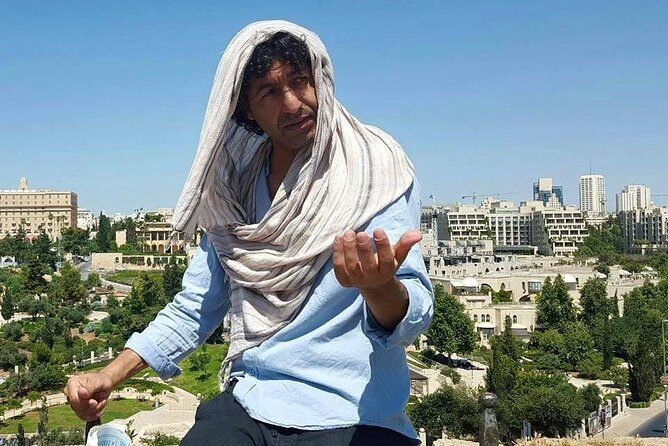
The content was designed and curated by Uri Goldflam of Travel Trailer Israel, a professional guide and educator with 30 years of guiding experience. You can feel that in the way the stops connect like a walking story, rather than a random list of churches. Still, this is self-guided. One of the clearest complaints is that some people wanted more “how, when, where” detail and closer-to-exact location guidance. If you’re the kind of traveler who wants every turn spelled out, keep your expectations realistic: you’ll get a route and explanations, but it won’t behave like a full live escort.
A few more Jerusalem tours and experiences worth a look
Starting at Seven Arches: the route begins with a real sense of place
The tour starts at Seven Arches in Jerusalem and ends at the Garden Tomb on Conrad Schick Street. That ending is important, because from there you can walk back toward the Old City or head up toward New City hotels and restaurants.
Seven Arches is a practical launching pad. From a navigation point of view, it’s a recognizable area for starting your walk, and it helps you get oriented before you begin descending through the sites.
Physically, plan for a steady walk with stairs. The route is described as requiring moderate fitness, and that’s honest. You’ll also be moving through areas that can feel noisy at street level and quieter when you reach church courtyards or garden spaces. If you pace yourself and treat it like a “slow pilgrimage walk” rather than a sprint, the 4-hour timing will feel comfortable.
One more small note that affects your day: you’ll be visiting places where you may need a ticket or pay a fee. This isn’t a single gated attraction where you handle everything once. A phone-based tour works best when you’re okay with popping in and out, and when you keep an eye on admission instructions as you go.
Mount of Olives to Dominus Flevit: big views, then a quieter pocket
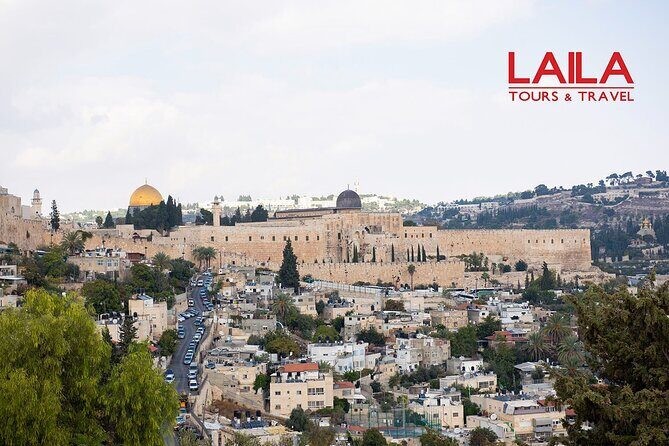
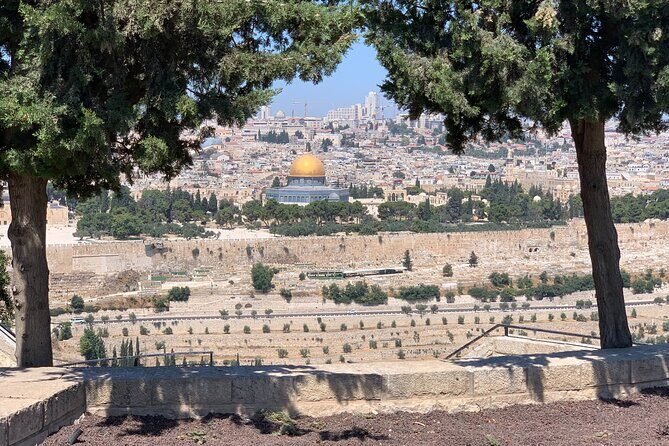
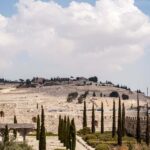
Your first major stop is the Mount of Olives, where you get an iconic Jerusalem view. The experience starts with a quick introduction to where you are and what you’re about to walk through. Then you move down the “Palm Sunday Road” toward the next stop.
This is also where Jerusalem’s practical side shows up. The observation deck can have peddlers, and you might even see camel rides set up for photos. I’d treat that as scenery, not a distraction. If you want pictures, be smart about it: keep your belongings secure, and only engage if you feel good about the situation. Otherwise, focus on the view and the direction of your route.
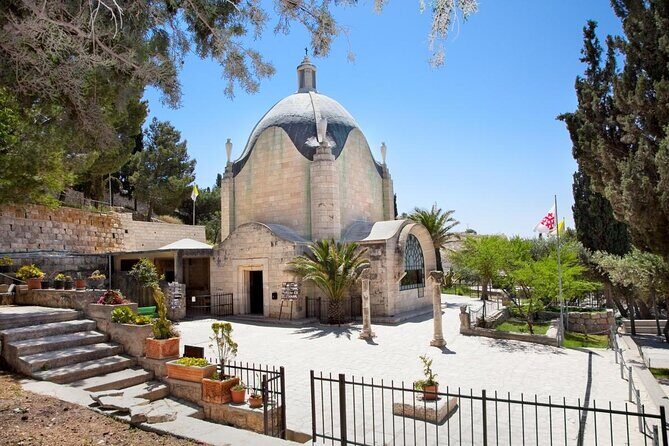
Next comes Dominus Flevit Church, traditionally tied to Jesus’ tears as he prophesied the destruction of Jerusalem. The church’s shape is described as tear drop—a distinctive detail you won’t get from just looking at it from the street. Inside, the standout is the special window overlooking the old city and the Church of the Holy Sepulcher. That window view is a natural “take a breath” moment.
There’s also an adjacent deck designed for meditation. If you’re someone who likes a pause more than another photo, this is a good place to slow down. The tour pacing here makes sense: big outlook first, then a contained quiet space before you head deeper into the day.
Gethsemane gardens and the Tomb of Mary in the Valley of Kidron
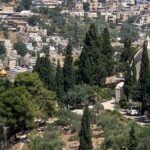
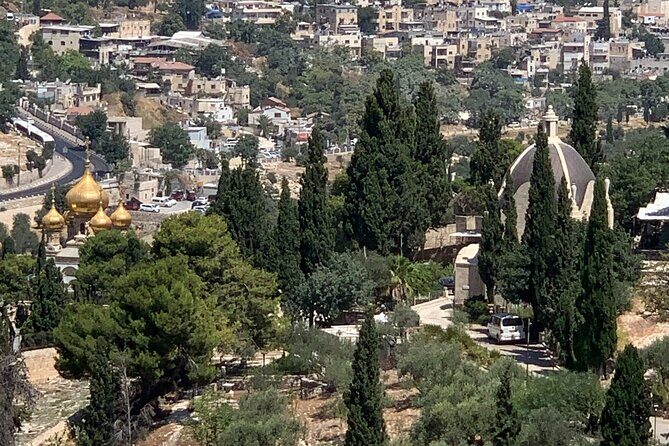
As the walk continues, the “Palm Sunday Road” winds down toward the Valley of Kidron. The route leaves the busier street feel and brings you into a sharper contrast: the garden atmosphere. That shift is one of the tour’s best strengths because Jerusalem can be overwhelming if you keep everything at street level.
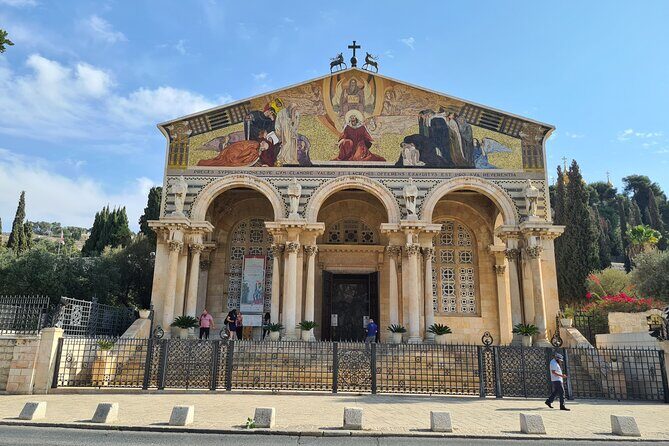
Stop 3 is the Garden of Gethsemane, at the Church of All Nations (also known as the Church of the Agony). The setting is described as an olive tree garden with trees that can be hundreds or even thousands of years old. Even if you stay practical and don’t try to “prove” anything with your own eyes, the atmosphere does the work. This is exactly the kind of place where sitting for a bit and letting your phone narration become background feels right.
Then you continue a bit further into the Valley to the Tomb of the Virgin Mary. Here, the setting is more down-to-earth and archaeological-feeling. The tomb is below street level, and what remains is tied to an old basilica and Crusader period construction. On the right side of a wide stairway leading down to the crypt, you can find the tomb of Queen Melisende of Jerusalem (daughter of King Baldwin II). That’s a genuinely specific historical name, and it helps anchor the site beyond the Gospel narrative.
This middle stretch is ideal if you want less hustle and more atmosphere. It’s also where your phone-based pacing really matters. You’ll get the best experience if you don’t treat every stop like a checklist. Give yourself time at least for the garden quiet and the tomb stairway descent—those are moments you can’t rush without losing something.
Pools of Bethesda and the Neoclassic echo of St. Ann
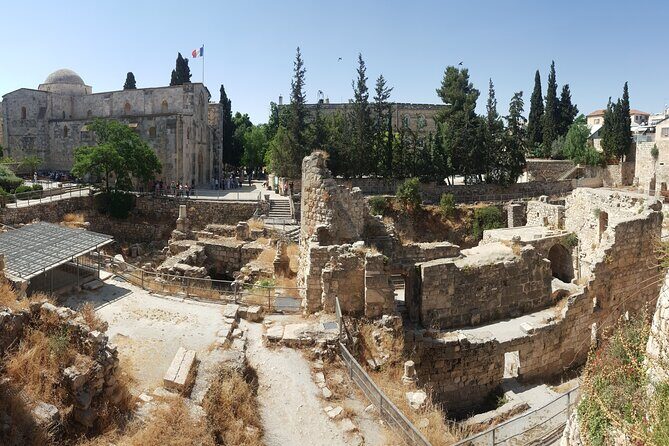
Then you hit the Pools of Bethesda, linked to the Gospel scene in John 5 where Jesus heals a man who had been unable to walk for 38 years.
This stop has a clear practical difference: it’s the first place where you pay an entry fee. Admission here is 5 shekels per person. Plan that in early so you don’t feel surprised later.
The nearby Church of St. Ann is described as neoclassical, and the audio experience is part of the point: echoes are designed for singing. Even if you’re not there for music, that detail gives you a hint about how the space is meant to sound. I’d use it like this: take a slow step around, notice the way voices carry, and then let that add texture to the Gospel setting.
A smart tactic for this stop: since the fee is small and the site is compelling, don’t just rush through. Give yourself time to see the pools area and then take a few minutes in and around the church space. It’s one of the best “mix of story + place” moments on the route.

Via Dolorosa to Austrian Hospice: bronze station markers and a rooftop break
After the pools, you begin walking along the Via Dolorosa, also described as the Way of the Suffering or the Passion of Christ. The route mentions that the stations are marked with round bronze plates. That detail matters because it helps you feel oriented even when streets get loud.
One of the more livable moments here is the Austrian Hospice. It’s described as hiding a slice of European hospitality behind large wooden doors off the bustling market street. The vibe shift can be real: you move from street noise into a more sheltered space.
There’s also a rooftop view. The tour notes a 5 shekel turnstile for the rooftop. If you’re the kind of person who enjoys views but hates “tourist trap” feelings, this might be a good compromise: you’re paying for a short, contained break with a meaningful overlook.
And yes, there’s food. The hospice is described as having excellent coffee and apple strudel. This is not just a snack stop. It’s also a reset. You’re walking a symbolic route, so taking a breather in a calm courtyard or café corner helps you keep the day from turning into constant motion.
From Damascus Gate to the Garden Tomb: finishing where the story lands
Next comes Damascus Gate, reached by following the market alley to the right (slightly uphill) after leaving the Austrian Hospice area. The current gate is described as Ottoman period construction, around 1536, and you can also see remains of Roman period gates below it.
Why does that matter? Because it gives you a layered Jerusalem moment. You’re moving from story-based spaces into a city-wall space that’s purely about how Jerusalem grew and changed. If you like seeing time layered into stone, you’ll appreciate this.
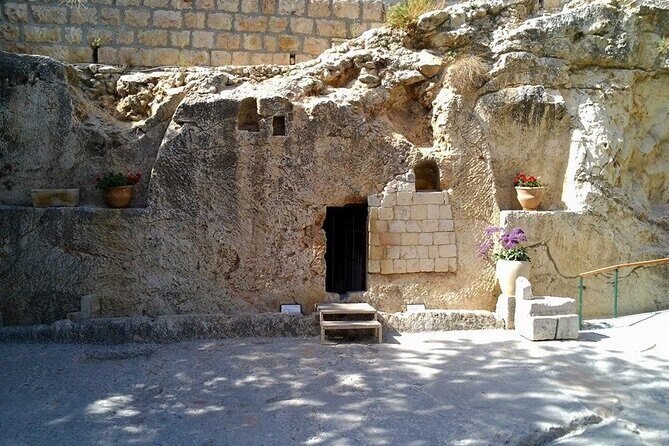
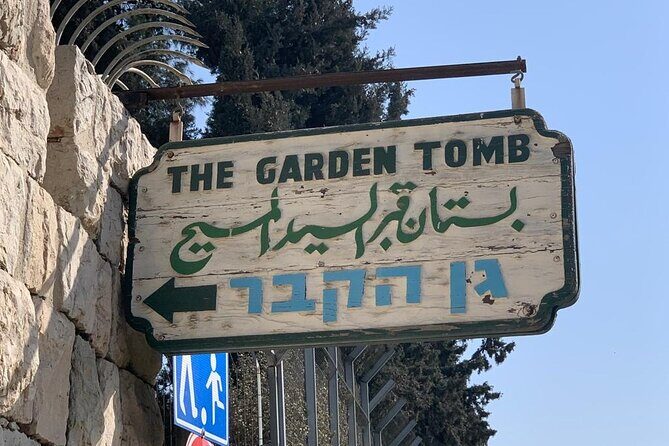
From Damascus Gate, the road to Damascus leads you toward the Garden Tomb, described as one of the possible sites for the crucifixion, burial, and resurrection. The Garden Tomb was identified in the late 19th century, and it’s owned and managed by the Protestant Garden Tomb (Jerusalem) Association, a charitable trust based in the United Kingdom.
The Garden Tomb experience includes free entry and lots of options for quiet:
- chapels and quiet corners for prayer and reflection
- views of the Skull caves of Golgotha
- the chance to enter the empty tomb
This is one of the best places on the route to let your phone narration stop feeling like a “tour” and start feeling like a guide to your own attention.
One big scheduling caution: the Garden Tomb is closed to visitors on Sunday and Monday. The tour can still be done those days, and you can return Tuesday through Saturday. Also note the opening hours listed for 03/16/2022 to 06/17/2026: Monday–Thursday 8:00 AM to 5:00 PM. If your travel dates fall on Sunday or Monday, plan around this or you may end up doing all the route steps without the final tomb visit.
What I’d expect from the pacing (and why some people want more)
This is designed as a 4-hour self-guided walk with set stops and suggested time ranges. The best part of that design is control: you can read, listen, and pause without needing to keep up with a group.
But here’s the tradeoff you should expect based on the experience itself: self-guided means you’re responsible for navigation and for deciding how much information to use. Some people wanted more detail, including how and where to get as close as possible to exact locations. If you’re picky about precision—like you want the exact point where you’re standing relative to a specific biblical event—then you may feel the experience is lighter than you want.
My practical advice: treat the app like a framework, not a replacement for good street awareness. Move slowly at each stop. Look for the cues the tour provides. If something feels unclear, pause and use your phone map to confirm you’re at the right spot before you move on.
Who should book this day tour
I think this tour fits best if you:
- want a self-guided experience where you can control the pace
- like faith-and-place history more than you need a live group explanation
- enjoy prayer or reflection in actual church/garden settings
- are comfortable walking and using stairs for about 4 hours
It’s also a good match for small groups. The tour/activity has a maximum of 2 travelers, which can make the experience feel calmer and more personal, even though you’re using a phone rather than a person.
If your priority is a strict, fully scripted guided narration with lots of extra context at every stop, you might find this too minimal. The structure is there, but it’s not trying to replace a full tour guide.
Practical tips to make it smoother
- Have the app ready before you start. You’ll receive a coupon-code after purchase, and the code is shared in the confirmation email under the Before You Go section.
- Budget for the paid entries. Pools of Bethesda is 5 shekels, and Austrian Hospice rooftop uses a 5 shekel turnstile.
- Plan for the Garden Tomb closure. If you’re there on Sunday or Monday, you won’t be able to visit the Garden Tomb that day. Build in a return on Tuesday–Saturday.
- Use the stop time as a suggestion. Some stops are quick, like the Tomb of the Virgin Mary, while others benefit from longer pauses, like Gethsemane and the Garden Tomb.
- Wear shoes for stairs. Valley-of-Kidron descents and tomb areas can mean uneven steps. Moderate fitness is enough for most people, but don’t dress for sightseeing flats.
Should you book In the Footsteps of Jesus Day Tour?
If you want a thoughtful, phone-guided route that helps you connect Jerusalem’s major Jesus-associated sites without being locked into a group schedule, this is a good buy for $7. The biggest reason to book is the way the day is paced with real stopping points: Mount of Olives for context, Dominus Flevit for a unique tear-shaped church experience, Gethsemane for quiet, and the Garden Tomb to finish.
Skip or reconsider if you crave very granular directions and a deeper, heavier narration at every corner. This isn’t marketed as a detailed live walk-through. It’s built to let you choose how much information you want.
Bottom line: book it if you like control and calm. If you need a high-touch guide who explains everything precisely, you’ll probably feel underfed.
FAQ
How long is the In the Footsteps of Jesus Day Tour?
It’s approximately 4 hours.
Where does the tour start and end?
It starts at Seven Arches, Jerusalem and ends at the Garden Tomb (Conrad Schick St, Jerusalem).
Is the Dguide app included?
Yes. The Dguide App is free, and after you purchase the tour you receive a coupon-code to access the In the footsteps of Jesus tour in the confirmation email.
Are all the stops free?
Not all. Mount of Olives, Dominus Flevit, Garden of Gethsemane, Tomb of the Virgin Mary, Damascus Gate, and the Garden Tomb are listed as admission free. Pools of Bethesda has an admission fee of 5 shekels per person, and Austrian Hospice rooftop uses a 5 shekel turnstile.
Is the Garden Tomb open every day?
No. The Garden Tomb is closed to visitors on Sunday and Monday. You can still do the tour on those days and return later (Tue–Sat.).
How many travelers can go on this experience?
The tour/activity has a maximum of 2 travelers.