REVIEW · JERUSALEM
Full-Day Private and Guided Tour of the Jerusalem’s Old City
Book on Viator →Operated by Uri Goldflam - Travel Trailer Israel · Bookable on Viator
Jerusalem’s Old City makes sense fast. This private, guided route connects the biggest spiritual landmarks with the archaeology underneath them, led by Uri Goldflam. You’ll move through the quarters like you’re following a storyline, from the hill where Jerusalem began to the Church of the Holy Sepulcher.
I really like two things about this experience. First, Uri’s explanations tie what you read in texts to what you see on the ground, so the stones don’t feel like trivia. Second, you cover all four quarters in a logical walk, including rooftop viewpoints, bazaars, and the major churches, not just a checklist.
One thing to consider: it’s mostly a walking tour with steps, alleyways, cobblestones, and some uphill stretches. You’ll want comfortable shoes and you should have moderate physical fitness, especially if your group includes anyone who’s slower on foot.
In This Review
- Key Highlights You’ll Actually Feel
- Why This Private Old City Route Works So Well
- City of David National Park: Where Jerusalem’s Story Starts
- Western Wall: Prayer, Focus, and the Weight of Tradition
- A Museum Under a Home: 1st-Century Villas and the Roman Turning Point
- Jewish Quarter: Time Capsules in the Streets
- Muslim Quarter: Rooftop Views, Golden Dome Framing, and Bazaar Reality
- Christian Quarter and the Holy Sepulcher: Where Several Traditions Intersect
- Tower of David Museum: Herod’s Citadel, City Views, and a Possible Trial Site
- After the Tour: Smart Ways to Use Your Remaining Time
- Who Should Book This Tour (And Who Might Skip It)
- Should You Book This Jerusalem Old City Private Tour?
- FAQ
- Is this tour private?
- What’s the group size and price?
- How long is the tour?
- Is hotel pickup included?
- Is this mostly walking?
- What about tickets and entrance fees?
- Is a mobile ticket used?
- Where does the tour start and end?
- Is service available for someone with a service animal?
- What’s the cancellation policy?
Key Highlights You’ll Actually Feel
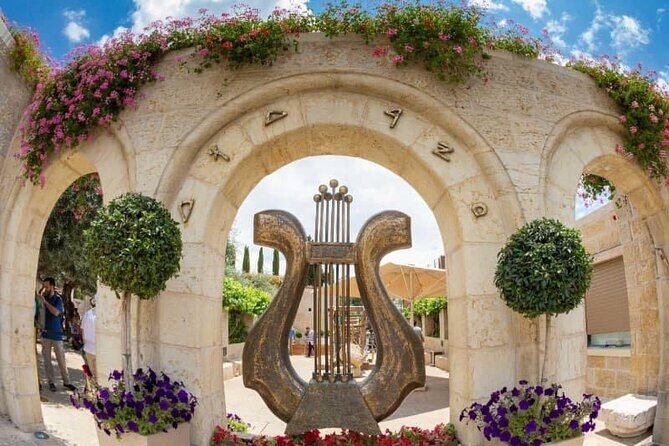
- Uri Goldflam’s on-the-ground storytelling connects Jerusalem’s layers across Bible, archaeology, and modern life.
- City of David + panoramic views gives you context before you start interpreting the rest of the Old City.
- Western Wall access right near the Temple Mount area keeps your perspective focused and grounded in what people come for.
- Four quarters, one day rhythm: Jewish, Muslim (rooftop to bazaar), Christian, then the Church of the Holy Sepulcher.
- Optional Tower of David Museum adds a 360-degree view and another angle on key moments in Jerusalem’s timeline.
- Walking logistics matter: plan for steps and uneven surfaces throughout the day.
Why This Private Old City Route Works So Well

Jerusalem’s Old City can feel like you’re running from one “must-see” spot to the next. This tour fights that problem with structure. You start with the foundational area, then you build outward through neighborhoods that each explain a different part of the city’s identity.
Because it’s private (up to 4 people), you’re not stuck with a rigid group pace. That matters in the Old City, where crowds, tight streets, and quick turns can throw off a normal bus tour. You can ask questions and slow down when something catches your attention. Uri’s style also tends to be straightforward and practical, so you’re not just hearing facts—you’re building understanding you can use while you wander on your own afterward.
Value-wise, the price is quoted per group (up to 4). At $870 per group, the math is really about whether you want personalized guidance for the day’s walking-heavy route. If you’re traveling as a couple or a small family, this can feel like a fair trade for (1) private transport and (2) a guide who can interpret what you’re seeing, not just escort you between sites.
You can also read our reviews of more guided tours in Jerusalem


City of David National Park: Where Jerusalem’s Story Starts
Your first stop is City of David National Park, presented as where it all began—Jerusalem’s early roots, long before the Old City walls and long after. This is the kind of place where your eyes need time to adjust. From the hill, you’ll get a panoramic view of ancient Jerusalem, which helps you understand why certain sites mattered.
Expect the site to be explained as a meeting point between Bible and archaeology. The tour frames the “why” behind the location: who lived here, what changed over time, and how different eras left physical evidence. You’ll also be able to connect later landmarks to this starting point, so the day doesn’t feel like random sightseeing.
Time on this stop is about 2 hours, and admission to the park isn’t included. If you’re budgeting, count on paying here separately. Still, this is one of the best places in the city to invest time because it gives context for everything you’ll see next.
Practical tip: since you’re starting early in your walking day, wear shoes that grip well on uneven paths and bring water. Even if you’re fit, the ground here is not made for dress shoes and impatience.
Western Wall: Prayer, Focus, and the Weight of Tradition
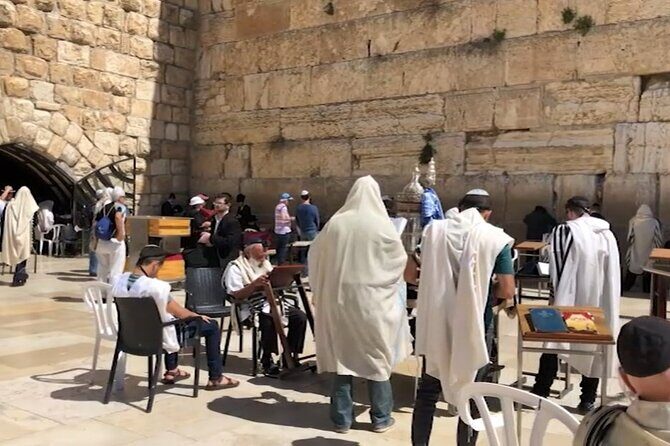
Next comes the Western Wall. This is described as the closest place for Jews to pray to the Temple Mount area, so the focus is not just architecture—it’s meaning. Even when you’re not there for religious practice, you’ll feel how much reverence is built into the space.
The stop is short—around 20 minutes—and admission is free. That’s a good thing on a day like this. It keeps your energy for the more time-consuming portions, and it keeps you from turning this into another rushed photo stop.
One consideration: Western Wall areas can be emotionally intense and busy depending on the time of day. If you like quiet moments of reflection, use your guide’s pacing and don’t try to sprint for the “best angle.” The point here is respect and understanding, not speed.
A Museum Under a Home: 1st-Century Villas and the Roman Turning Point
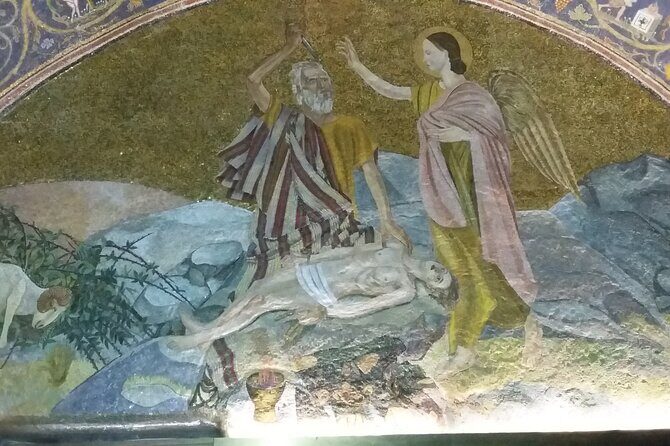
The tour then includes a unique museum setting: archaeological remains of opulent villas from the 1st century AD, housed in the basement of a residential building. The description also notes that they were likely connected to priests who served in the Temple.
This stop is powerful because it shifts the question from holy-site reverence to daily life and institutional power. You’re seeing what kind of people and structures existed around the Temple era, and then the story turns toward the destruction of Jerusalem by the Romans in 70 AD. In other words, it doesn’t just say the city changed—it shows you how the change left physical traces.
Since admission details aren’t fully listed for this specific museum, plan to follow your guide’s direction on what’s included versus what isn’t. Either way, the value is in the perspective: you see the city as lived-in, not just visited.
Jewish Quarter: Time Capsules in the Streets
In the Jewish Quarter, the tour focuses on archaeological remnants as clues. The idea here is slow reconstruction—little fragments in the street that help you “build the puzzle” of Jerusalem’s turbulent history.
The Jewish Quarter stop is about 1 hour, with admission included. That inclusion matters, because it turns this section from a passive walking segment into a structured interpretation moment. You’re not only moving through streets; you’re learning how these layers connect.
This portion also helps you see Jerusalem as a city of continuity and disruption at the same time. The streets may look like “old town” tourism, but your guide frames them as evidence—stuff you can learn from without needing a museum ticket for every step.
Tip: if you enjoy tracing timelines, this is where you’ll start connecting earlier eras (City of David) with later outcomes (Western Wall and beyond). It’s a bridge section.
You can also read our reviews of more city tours in Jerusalem






Muslim Quarter: Rooftop Views, Golden Dome Framing, and Bazaar Reality
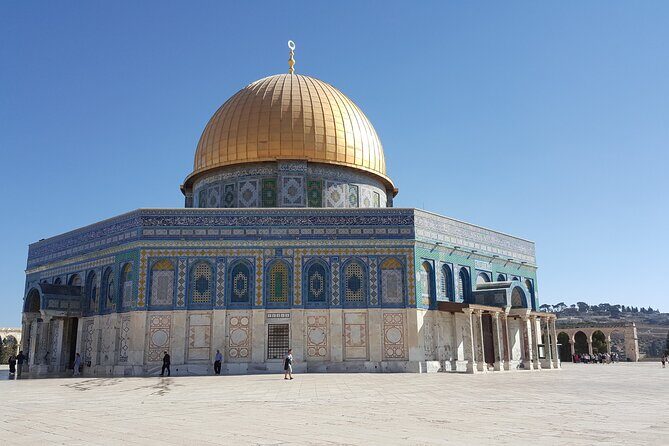
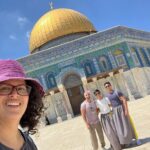
The Muslim Quarter is where the tour becomes more sensory. It starts with a rooftop observatory for panoramic views of the entire Old City and a clear look at the Golden Dome. That rooftop moment is more than a view. It gives you spatial memory, which helps you later when you’re trying to orient yourself inside the maze of streets.
From there, you walk through the Arab bazaar, which the tour describes as a mix of site, sound, flavors, and scents. You’re also encouraged to practice negotiation—because in a real market, pricing and interaction are part of the experience.
The stop is about 1 hour with admission included. The walking time plus market atmosphere means you’ll want a practical mindset: look, ask, compare, and don’t assume the first price is the final one. If you’re uncomfortable bargaining, you can still watch the process and learn how the conversations work.
This section can be a highlight if you like living culture, not just monuments. It’s also a good reset after the heavier historical stops, because the mood shifts to street-level energy.
Christian Quarter and the Holy Sepulcher: Where Several Traditions Intersect
Next is the Christian Quarter. This area is presented as holding many churches and steeples, with time permitting visits to some lesser-known spots in the alleys. But the anchor is the Church of the Holy Sepulcher.
The stop is split into two parts. First, you spend about 30 minutes in the Christian Quarter, with admission included. Then you go into the Church of the Holy Sepulcher for about 45 minutes, also with admission included.
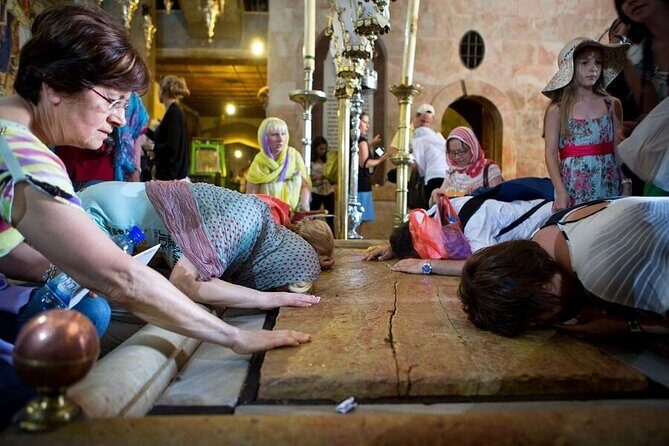
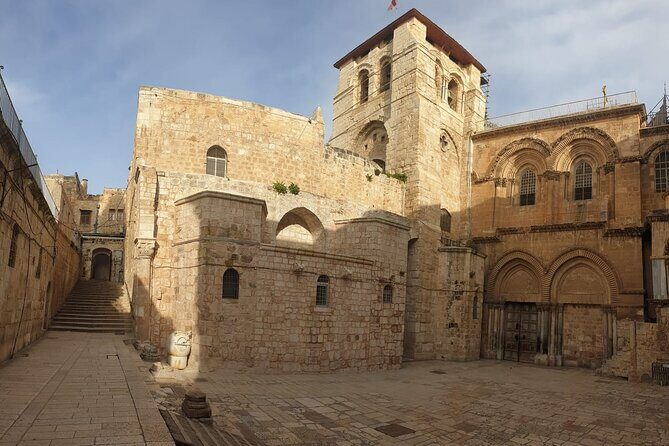
The Church of the Holy Sepulcher is described as revered by Christians worldwide as a possible location for the Crucifixion and Resurrection of Jesus. It’s managed by the Catholic, Orthodox, Armenian, and Coptic Churches. That management detail matters because it shapes what you’ll see—multiple communities with shared responsibility in the same sacred space.
This is one of the most important stops in Jerusalem, but it can also be crowded or intense. The guide’s role here is to help you interpret what you’re looking at without turning it into a rush job. You’ll get a sense of how different Christian traditions connect to the same building complex, which is a useful way to understand why people take the time they do here.
Practical tip: the church can feel physically packed. Pace yourself, and give yourself permission to look slowly rather than trying to “cover” everything in one sweep.
Tower of David Museum: Herod’s Citadel, City Views, and a Possible Trial Site
The optional stop is the Tower of David Museum of the History of Jerusalem. This is where the tour adds high vantage points and another layer of interpretation.
The tour describes the site’s origin as Herod the Great’s private palace in Jerusalem, later used as a seat of government for Roman prefects and then for Christian and Muslim kings and queens. In the museum, you’ll see galleries tied to different historical periods, and the tallest tower offers a 360-degree view of both the old and new city.
There’s also a mention of recent excavations and a possible location for the trial of Jesus in front of Pontius Pilate. That claim is presented as possible, not absolute—so you get the story with the right level of historical caution.
This stop is about 1 hour 30 minutes, and admission is not included. If you’re the type who likes views and timelines, it’s worth budgeting for. If you’re more focused on the core religious sites, you might skip it to keep your day from stretching too long.
Either way, even standing where the tower overlooks the city helps tie everything together. After a day of quarters and churches, a top-down view is like a mental reset.
After the Tour: Smart Ways to Use Your Remaining Time
The tour ends back at the meeting point, at the cusp between old and new. You’ll have time afterward to return to Old City markets for shopping or head into the new city for restaurants.
Here’s the key: you won’t be starting from zero. Because the day runs from foundational geography to the four quarters, you’ll have an easier time choosing where to wander next. You’ll recognize which streets you passed, how the rooftops helped you orient, and why some areas felt more connected to certain stories.
If you’re planning photos, keep in mind the best light often changes quickly. If your schedule allows, pick one more area you liked best earlier in the day and spend extra time there rather than hopping around.
Who Should Book This Tour (And Who Might Skip It)
This tour is a strong fit if you want:
- a private guide who can explain what you’re seeing in plain, organized language
- a full sweep of Jerusalem’s Old City across Jewish, Muslim, and Christian areas
- a route that connects major sites with archaeology, not just sightseeing
You might look elsewhere if:
- you need very minimal walking and step-heavy routes (this tour includes steps, cobblestones, and some uphill walking)
- you don’t want to pay optional admissions for City of David or the Tower of David
- you prefer a mostly outdoors, monument-only day with fewer indoor moments
Should You Book This Jerusalem Old City Private Tour?
If you’re deciding between self-guided wandering and a guided day, this is the kind of tour that justifies a guide. The Old City isn’t only about where things are—it’s about why they matter and how the layers connect. Uri Goldflam’s style, based on what many people praise, focuses on clarity and context, with an ability to answer questions and handle sensitive topics thoughtfully.
Also, you’re getting more than the headline sites. The walk includes archaeology under a residential building, quarter-by-quarter exploration, and optional access to a tower museum with sweeping views. That turns the day into a meaningful framework, not a pile of stops.
My practical recommendation: if you can handle walking and you want one well-timed guided day that makes Jerusalem feel understandable, book it. If you want total flexibility and minimal cost, you might prefer a shorter or self-guided plan.
FAQ
Is this tour private?
Yes. It’s a private tour/activity with only your group participating, up to 4 travelers.
What’s the group size and price?
The price is $870.00 per group (up to 4). That means the cost is based on your group, not per person.
How long is the tour?
The duration is listed as 2 to 8 hours (approx.), depending on timing and choices during the day.
Is hotel pickup included?
Hotel pickup is available for groups of up to 4 travelers. Otherwise, you’ll meet at the listed start location, and transportation is provided as part of the tour.
Is this mostly walking?
Yes. The tour is a walking tour that includes many steps, alleyways, smooth cobblestones, and some uphill walks, even though private transportation is included.
What about tickets and entrance fees?
City of David National Park admission is not included. Tower of David Museum admission is optional and not included. Admission for the Western Wall is free, and admissions are listed as included for the Jewish Quarter, Muslim Quarter, Christian Quarter, and the Church of the Holy Sepulcher.
Is a mobile ticket used?
Yes, the tour includes a mobile ticket.
Where does the tour start and end?
It starts at Yaffe Tours, Omer Ben Al Khattab 26, Jerusalem. It ends back at the meeting point.
Is service available for someone with a service animal?
Service animals are allowed.
What’s the cancellation policy?
Free cancellation is offered if you cancel up to 24 hours in advance of the experience start time for a full refund.