REVIEW · TEL AVIV
Urban Walking & Food Tour in Tel Aviv
Book on Viator →Operated by Booqify - Amazing Jerusalem · Bookable on Viator
Tel Aviv makes more sense on foot. This half-day urban walking and food tour strings together major neighborhoods in a smart route, from Rothschild Boulevard and the Bauhaus “White City” to Neve Tzedek, Carmel Market, and Kerem HaTeimanim—so the city feels connected instead of random.
What I like most is how it turns architecture into stories you can actually picture. I also really appreciate the way the guide balances walking with comfort and food stops—so you end the tour with more than photos, you’ve got a clearer sense of Tel Aviv’s identity.
The one real consideration: you’ll be on your feet for about 5 hours, and the tour depends on good weather. Also, lunch/food coverage is a bit confusing in the tour info—one part says lunch is included, another part notes about $40 pp for lunch and drinks—so I’d confirm exactly what’s covered when you book.
In This Review
- Key Points Worth Your Attention
- What This Tour Actually Feels Like: Walking Pace, Group Size, Mobile Ticket
- Rothschild Boulevard and Habimah Square: Tel Aviv’s “Modern Start” in Plain Sight
- Norman Hotel, Pagoda House, and Beit Levin: When Tel Aviv Buildings Get Weird (In a Good Way)
- Light Rail, the Great Synagogue, and Migdal Shalom Tower: Tel Aviv’s Layers, Explained
- Founders Monument to Meir Dizengoff: The City’s Founding Money and Founding Myths
- Neve Tzedek, Park HaMesila, and Aharon Chelouche House: From Tiny Neighborhood to Design Scene
- Suzanne Dellal Centre and the Dance Legacy Built Over School Ruins
- Carmel Market: The Part Where You Stop Thinking and Start Eating
- Kerem HaTeimanim: Yemenite Immigrant Stories in Narrow Streets That Still Feel Old
- Why the Tour’s Guide Matters: Clear Context, Heat-Smart Pacing, and Real Enthusiasm
- Price and Value: How $500 Per Group Works (and When It’s a Tough Sell)
- Should You Book This Tel Aviv Walking Food Tour?
- FAQ
- How long is the Tel Aviv walking and food tour?
- What is the group size limit?
- How much does the tour cost?
- Where does the tour start and end?
- Is lunch included in the price?
- What time does the tour begin?
- What’s the cancellation policy and what if weather is bad?
- Is it suitable if I use public transportation or need service animals?
Key Points Worth Your Attention
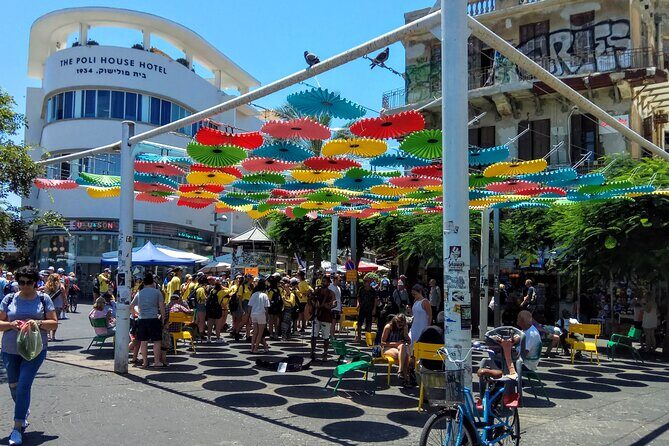
- Small-group feel (capped at 10): you get more attention than the big-bus crowd.
- Bauhaus plus real neighborhoods: Rothschild Boulevard isn’t just pretty buildings—it’s the start of modern Tel Aviv.
- Neve Tzedek to Kerem HaTeimanim: you see how Jewish communities shaped the city in different waves.
- Carmel Market time: you get a full chunk of time there, not a quick glance.
- Comfort-minded pacing: the guide is attentive about shade and breaks when it’s hot.
- Food stops with variety: tastings are described as diverse, and you’ll likely eat enough for the evening.
What This Tour Actually Feels Like: Walking Pace, Group Size, Mobile Ticket
This tour is designed as a half-day, on-foot experience, roughly 5 hours, starting at Habimah Theatre (Tarsat Ave 2) at 10:00 am. You finish at Coffee at the market near Carmel Market (HaCarmel St 33), which is convenient if you want to keep wandering on your own after the tour.
One detail I appreciate: it’s a small-group tour capped at 10 participants, not a mass event. Pricing is listed as $500 per group (up to 6), which matters for value. If you’re traveling with friends and can book as a group of 4–6, the per-person cost drops fast. If you’re solo, it can feel pricier—though the small-group cap helps keep it from feeling impersonal.
Also, it uses a mobile ticket, which is exactly what you want on vacation. Less paper, fewer steps, more time to focus on streets and storefronts.
You can also read our reviews of more walking tours in Tel Aviv

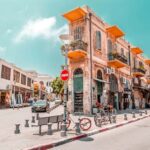
Rothschild Boulevard and Habimah Square: Tel Aviv’s “Modern Start” in Plain Sight
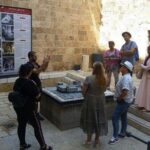
You begin in Habimah Square, where Rothschild Boulevard, Hen Boulevard, Dizengoff Street, and Ben-Zion Boulevard all meet. This is a good opener because it puts you at a crossroads of today’s Tel Aviv while pointing you toward how the city grew into its modern self. Habimah Theatre is here, and the square connects to the story of Israel’s early Hebrew-language theatre—one of those cultural milestones that helps explain why Tel Aviv feels different from older Middle Eastern cities.
Then you move onto Rothschild Boulevard, Tel Aviv’s first boulevard and often considered the most famous street in Israel. The key idea here isn’t just that the boulevard is iconic; it’s that you can walk along the edge of the Bauhaus / International-style buildings that earned Tel Aviv the “White City” nickname. The tour also makes short detours, then brings you right back to Rothschild Boulevard until you reach Ahuzat Bayit—widely described as the first neighborhood of Tel Aviv.
What makes this part of the walk satisfying is that the guide doesn’t treat architecture as wallpaper. You get a sense of the early ambition: new streets, new building styles, and a city taking shape quickly rather than slowly.
A quick practical note: this section is longer on open streets than you might expect. If you’re heat-sensitive, you’ll want good water habits and sun protection.
Norman Hotel, Pagoda House, and Beit Levin: When Tel Aviv Buildings Get Weird (In a Good Way)
After Rothschild, you’ll swing by Nachmani St 23, an area connected with two standout structures: the Norman Hotel and the Pagoda House. This is where Tel Aviv’s architecture starts to feel playful—less “all uniform modern” and more “modern, but with personality.” Even if you only catch these buildings from the street, the point is to train your eye to see what makes Tel Aviv distinct.
Next up is Beit Levin, also nicknamed The Castle and the KGB House. That’s the kind of label that usually makes you wonder what the building is doing there. In this stop, you’re meant to understand why it earned those nicknames and what it says about the city’s mix of eras and influences.
If you love urban design, this segment is a nice palate cleanser. It breaks up the longer political and institutional stops with something more visual.
Light Rail, the Great Synagogue, and Migdal Shalom Tower: Tel Aviv’s Layers, Explained
From here, you’ll pass Yehuda ha-Levi Street, where the tour points out the location of one of Tel Aviv’s new light rail stations. Even though it’s a modern project, it fits the walking theme: Tel Aviv constantly redraws itself, and the guide links today’s infrastructure back to the city’s ongoing development.
Then you’ll briefly pass the Tel Aviv Great Synagogue. A helpful detail: it’s easy to miss if no one tells you, so the stop is basically a shortcut to noticing it. Planned by the founders of Tel Aviv but built many years after the surrounding neighborhood, the synagogue’s timeline adds a layer of meaning—your takeaway is that planning and execution don’t always match in real cities.
You’ll also see Migdal Shalom Tower, described as the first skyscraper in the Middle East, built on the site of the first Hebrew high school, HaGymnasia. That combination—early education + early vertical ambition—helps you understand how Tel Aviv tied learning to modernity.
And then the tour reaches Herzl St 2, tied to two powerful symbols: Akiva Weiss, described as the initiator to build Tel Aviv, and a statue of Alfred Dreyfus, connected to the French case known as L’Affaire. The story connects that injustice to Theodore Herzl, and the tour uses it to show how modern political momentum links back to the emotional realities of antisemitism and justice.
This set of stops works especially well if you want more than dates. It’s about how people and ideas stamped themselves onto specific corners and buildings.
Founders Monument to Meir Dizengoff: The City’s Founding Money and Founding Myths
Two quick but meaningful stops sit right along Rothschild Boulevard. First is the Founders Monument and Fountain, commemorating Jewish families who chipped in money to create a modern neighborhood that became known as Tel Aviv. It’s a concrete reminder that city-building wasn’t only top-down—it was also ordinary people pooling resources.
Right after that, you’ll see the Meir Dizengoff statue—Tel Aviv’s first mayor—on his horse in front of his house. The tour also connects this location to 1948, when David Ben-Gurion declared a new Jewish state in that house after what’s described as a 2000-year absence.
I like this part because it keeps the founding story from floating in the abstract. You’re standing in the physical places where the story claims its footing.
You can also read our reviews of more food & drink experiences in Tel Aviv





Neve Tzedek, Park HaMesila, and Aharon Chelouche House: From Tiny Neighborhood to Design Scene
Now you shift into a different feel, where the streets narrow and the atmosphere becomes more neighborhood-like. The tour heads to Neve Tzedek, described as the first small Jewish neighborhood outside the walls of Jaffa in the 19th century, followed by other small communities for different social and ethnic Jewish groups. Today, Neve Tzedek is known for low-rise houses and synagogues, plus modern retail—design stores, fashion boutiques, handicrafts—and a handful of good restaurants.
This is also where you get a sense of how Tel Aviv’s identity keeps layering. The past doesn’t disappear; it changes clothing.
The tour also passes Park HaMesila, a newer urban park that connects the beach with downtown Tel Aviv along the route of the old Ottoman railway. The practical note is that the light rail’s red line will ride under this park—so again, you’re seeing past and present in the same corridor.
Then you’ll stop at the Aharon Chelouche House. The story here is immigration history: Aharon came to the Holy Land in a Mizrahi Aliya, described as about 50 years before the Ashkenazi Aliyot. He paid for the plot of land called Neve Tzedek and built the first house there, including a private synagogue. That makes the neighborhood’s origin feel personal, not just historical.
Suzanne Dellal Centre and the Dance Legacy Built Over School Ruins
Next is the Suzanne Dellal Centre, home to the Batsheva Dance Company and Inbal Dance Theater. It’s built on the ruins of the Alliance School for Boys and the Yechiely Girls School (1908), and the renovation is described as restoring the site with a restored piazza.
Even if modern dance isn’t your thing, I think this stop is worth it because it shows how Tel Aviv repurposes space. Education schools turn into performance spaces; memory stays in the stones, even when the function changes.
It’s also a nice reset before the big food stop ahead.
Carmel Market: The Part Where You Stop Thinking and Start Eating
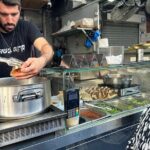
Then comes the centerpiece of the “food tour” side: Carmel Market (Shuk HaCarmel). You get about 1 hour 45 minutes here, which is enough time to actually browse and sample, not just stand at one stall and move on.
The market is described as selling everything from clothing to spices, vegetables, and even electronics. But what you’ll likely notice in your own stroll is the mixture: besides traditional trading, there are also trendy spots for bars, restaurants, coffee shops, and chef-owned food stalls.
Two practical points. First, the tour info says complimentary tea or coffee, so treat that as a built-in pause. Second, the lunch/food part is messy in the provided details: one section frames lunch as included, while another lists lunch and drinks as about $40 pp. Because of that, I’d go in prepared to pay for at least part of your meal, unless your booking confirmation clearly states otherwise.
If you want a simple strategy: come hungry, move slowly early so you can compare options, and don’t over-commit at the first stand.
Kerem HaTeimanim: Yemenite Immigrant Stories in Narrow Streets That Still Feel Old
After Carmel, the tour heads to Kerem HaTeimanim, described as an early 19th-century poor neighborhood for Jewish immigrants from Yemen. The tour explains that residents started a market that eventually became the largest one in Tel Aviv—Carmel Market. That’s a neat origin story: one of the city’s liveliest food areas traces back to hardship, rebuilding, and community commerce.
The tin shacks and wooden houses are gone now, but narrow streets remain, plus small restaurants and ground level houses. This stop is brief, but it changes how you feel about what came right before. The food you just tasted becomes tied to a human story, not just a tourist activity.
Why the Tour’s Guide Matters: Clear Context, Heat-Smart Pacing, and Real Enthusiasm
In the feedback for this tour, the name Menno comes up as a guide who connects the dots clearly. The biggest theme in the comments is how he explains the city’s history in a way that doesn’t overwhelm you. That matters because this route has a lot going on—architecture, politics, immigration stories, and neighborhood change—all in one walk.
Another strong point: the guide’s practical approach during hot weather. There are mentions of finding shaded areas, plus bathrooms and places to rest on benches. That’s not just comfort; it’s how you keep the walk enjoyable instead of turning it into a sweaty endurance test.
Finally, the food side is described as diverse and genuinely good. That lines up with the market timing and the idea that you’ll leave full enough for the evening.
Price and Value: How $500 Per Group Works (and When It’s a Tough Sell)
At $500 per group (up to 6), the tour isn’t a budget walk. But value depends on how you travel.
- If you’re in a group of 4–6, the cost becomes much more reasonable per person, and you benefit from the capped group size.
- If you’re solo, you might feel like you’re paying for the privilege of getting access to a knowledgeable guide and a planned route.
What you do get, beyond sightseeing, is an ordered way to understand Tel Aviv—starting with the early modern core along Rothschild Boulevard and then moving outward into neighborhoods shaped by different immigration waves. The guide also adds breathing room with shade and breaks, which is a hidden cost many group tours ignore.
As for what’s included: the info clearly states all fees and taxes and mentions complimentary tea or coffee. For lunch and drinks, the details are inconsistent, so treat that as a “confirm before you go” item.
Should You Book This Tel Aviv Walking Food Tour?
Book it if you want Tel Aviv in one half-day, with a plan that ties streets to stories. This tour is especially good if you care about Bauhaus architecture, enjoy neighborhood walking, and want Carmel Market that feels intentional instead of random.
Pass or adjust expectations if you’re sensitive to heat or you want a long, slow sit-down meal experience. This is a walking tour first. And if you’re counting tightly on lunch being fully covered, double-check the exact meal inclusions in your confirmation so you don’t get surprised at the market.
If you do book, do two things: wear comfortable shoes, and go into the market hungry enough to sample.
FAQ
How long is the Tel Aviv walking and food tour?
The tour lasts about 5 hours.
What is the group size limit?
The tour is described as a small-group experience capped at 10 participants.
How much does the tour cost?
The price is listed as $500 per group (up to 6).
Where does the tour start and end?
It starts at Habimah Theatre, Tarsat Ave 2, Tel Aviv-Yafo, and ends at Coffee at the market on HaCarmel St 33 near Carmel Market.
Is lunch included in the price?
The information says the tour includes lunch, but it also lists lunch and food/drinks as not included (about $40 pp). Confirm what your booking includes.
What time does the tour begin?
The start time is 10:00 am.
What’s the cancellation policy and what if weather is bad?
You can cancel up to 24 hours in advance for a full refund. The tour requires good weather, and if it’s canceled due to poor weather, you’ll be offered a different date or a full refund.
Is it suitable if I use public transportation or need service animals?
It’s listed as near public transportation, and service animals are allowed. It also says most travelers can participate.